what month was Romulus destroyed
Do we know what month Romulus was destroyed in, January or June 2387?.--TyphussJediVader 13:54, November 7, 2011 (UTC)
- It was never specified, as far as I can remember. I don't have a copy of The Needs of the Many, so I don't know what it says. It occurs at least sometime after stardate 64390.1 (Star Trek: Countdown) and stardate 64444.5 (The Path to 2409). --Lenonn 01:20, November 8, 2011 (UTC)
Novels v 2009 movie?
Considering that we tie in data from novels, comics, tv series and movies, how do we reconcile the discrepency between the reboot movie and the novels? In the movie, Romulus is destroyed (as shown), in the novels (especially the Typhon Pact series) Romulus still exists and very much a political forefront on activity within the Pact.
So, could we create a separate section for clarity like we do with characters, etc. Or should we keep it as is? 71.83.209.166 04:50, April 9, 2012 (UTC)J
- The novels are currently taking place in 2381 and Romulus was destroyed in 2387... we still have a few years to go before we have to figure that out (if indeed there is something to figure out). -- sulfur 11:25, April 9, 2012 (UTC)
Population 0
Hey, just putting this out there. if a planet is destroyed it doesnt have a population of 0. its not a planet anymore, there's no planet to assign a numerical figure to. if you want to change the sidebar to read the chronologically last known population figure and then tag it with "until 2387 destruction" it would be a lot less nonsensical. just stop changing the population to zero -- captainmike  11:37, June 8, 2020 (UTC)
Distance from Earth?
I don't think it's been established in aired Trek, but has it been established in the novels how far Romulus/Remus -- or at least the Neutral Zone -- is from Earth? I know that in ENT, it was a milestone for NX-01 to have traveled greater than 90 light years from Earth, but that doesn't automatically mean that the twin planets were greater than 90. It could just have meant that Earth starships hadn't traveled in their direction yet. Thanks in advance.
(I haven't found 128 Trianguli on Wikipedia. A quick Google search seems to indicate that Ms. Duane made up the star.) - RTS2011RN (talk) 10:23, 3 January 2021 (UTC)
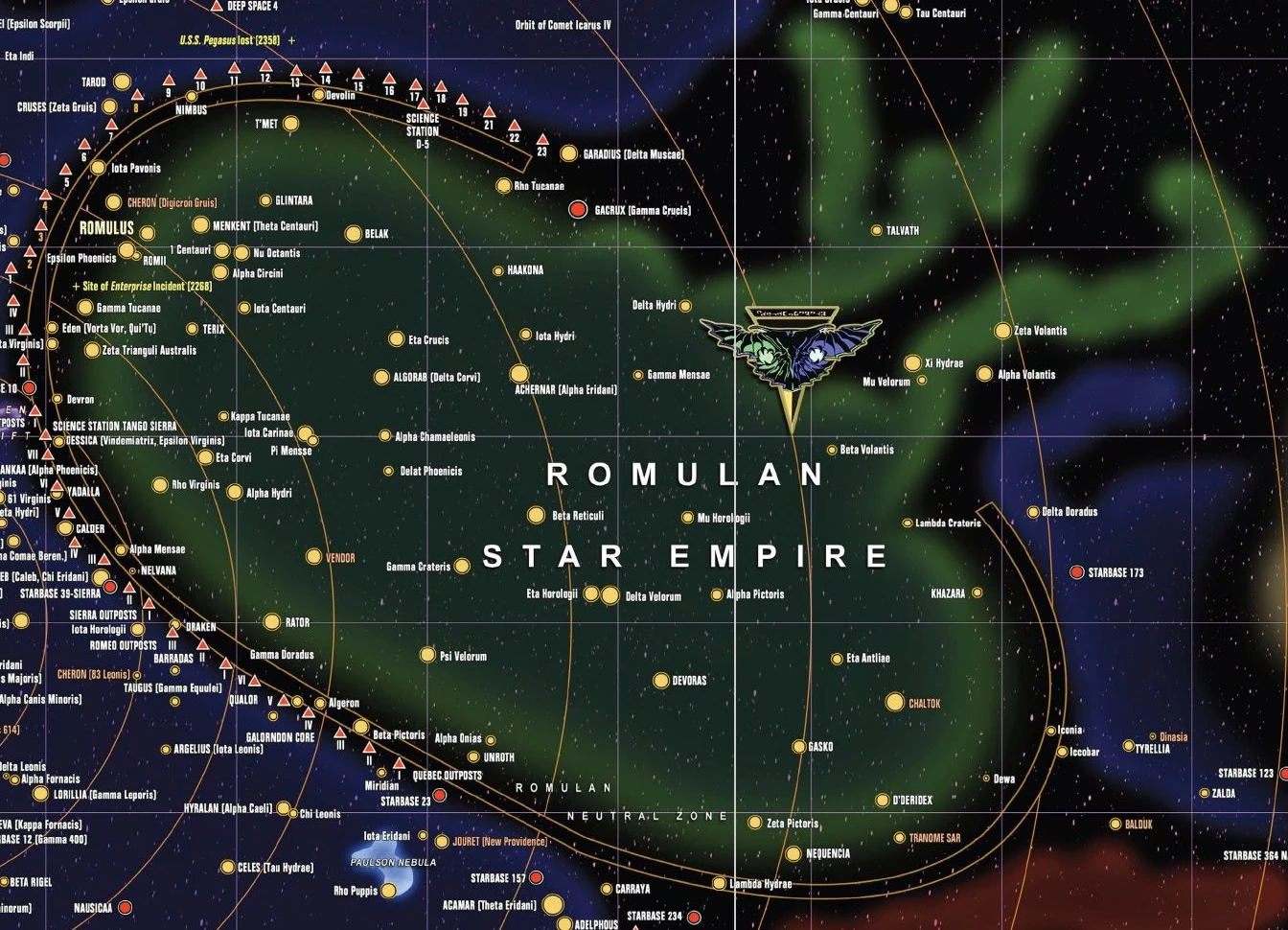

Star Chars.
- The ST: Star Chats indicates distance from Earth by equidistant concentric rings around Sol. If you determine the distance the rings represent, you have the rough distance of 128 Trianguli from Sol. Kind regards, -- Markonian 10:41, 3 January 2021 (UTC)
- Unfortunately, Star Charts is a 2 dimensinal map so using the rings and sector boxes does NOT give you accurate measurements - Romulus could be significantly above or below Earth on the galactic plane which could double the distance involved
- Also, 128 Trianguli is not a real star, but it was devised by Diane Duane. The Star Charts arrangement puts the Trianguli constellation in a different direction from their placement for Romulus, which means that there must be another constellation it is located in (possibly Trianguli Australis). -- captainmike
 13:30, 3 January 2021 (UTC)
Third of ten planets
What's the source of this information? The sources given on Romulus system (Diane Duane books, FASA RPG, Fleet Command and Infinite) show from 2 to 5 planets other than Romulus and Remus. JagoAndLitefoot (talk) 14:38, 19 October 2023 (UTC)
- The Way of D'era: The Romulans page 111. Gilgamesh de Uruk (talk) 15:32, 19 October 2023 (UTC)
- Since different sources give different numbering info for what is obviously the same planet in can i have frequently assumed that some numbering systems could be counting the total number of planets in the entire binary system, and others only count the planets orbiting the singular binary component. also it is possible that two planets sharing the same orbital (as is the case with Romulus and Remus) might be "counted once" in some systems and "counted twice" in others according to how they are numbered. this is the main reason why i might recommend against combining planets from unlike sources -- captainmike 16:30, 19 October 2023 (UTC)
- Problem is that both FASA and Last Unicorn (the two main conflicting sources) show the Romulus system as a single-star one, so all the planets there can be assumed to orbit only the primary.
- But another possible solution can be the fact that the first planet in The Way of D'era (Ket-cheleb I) is class D, which the wiki classifies as a planetoid, and therefore might not "count" depending on one's classification of planetary bodies. In this case, Ket-cheleb II would correspond to Stelam Rom'lnz I / Aranusia / Romula I. JagoAndLitefoot (talk) 19:40, 19 October 2023 (UTC)
The thing with that is that them portraying it as a single star system doesnt necessarily mean there isn't the additional star, just that the source isn't describing this to the level of detail that it would include the second star - not that the star definitively doesn't have a second star in those continuities - captainmike 00:43, 20 October 2023 (UTC)
- Fair enough. Also, come to think of it, Infinite doesn't actually show which planet orbits which star, since it always shows all stars in a system in the center and the planets in circular around them without separate orbits around each star, so Romula I, II and III could very well orbit Romulus B. JagoAndLitefoot (talk) 06:33, 20 October 2023 (UTC)